Conservation Biology of Freshwater Turtles and Tortoises
A compilation project of the IUCN/SSC Tortoise And Freshwater Turtle Specialist Group
Total Published to Date (2008–2026)
140 species accounts covering 182 taxa from 132 countries.
Plus 11 updated annotated checklists of all Turtles of the World (10 for modern taxa and 1 for recently extinct taxa).
3474 total pages, 306 contributing authors, 336 account photographers.
Most recent accounts and checklist published on: 26 September 2026
Currently edited by:
- Anders G.J. Rhodin
- John B. Iverson
- Peter Paul van Dijk
- Craig B. Stanford
- Eric V. Goode
- Kurt A. Buhlmann
- Russell A. Mittermeier
Publishers
- Published by Chelonian Research Foundation 2008–2016
- Published by Chelonian Research Foundation and Turtle Conservancy 2017–
Table of Contents
A hand-maintained, complete listing of every account — including species still in progress and those not yet assigned an account.
View the full Table of ContentsAbout the Project
This major compilation and assessment project of the IUCN SSC Tortoise and Freshwater Turtle Specialist Group is gradually producing individual species accounts on the conservation biology all 300+ modern freshwater turtles and tortoises of the world. Publication of these accounts is by Chelonian Research Foundation (joined since 2017 by Turtle Conservancy) as part of their publications series Chelonian Research Monographs (ISSN 1088-7105). The accounts are published online here on the TFTSG website and will continue to be published on a regular basis over the course of many years. All accounts published here are downloadable open-access and fully citeable peer-reviewed scientific articles, each identified by a unique DOI (digital object identifier) number, as practiced by leading online journals. The entire work is modeled loosely on the format established by the Catalogue of American Amphibians and Reptiles.
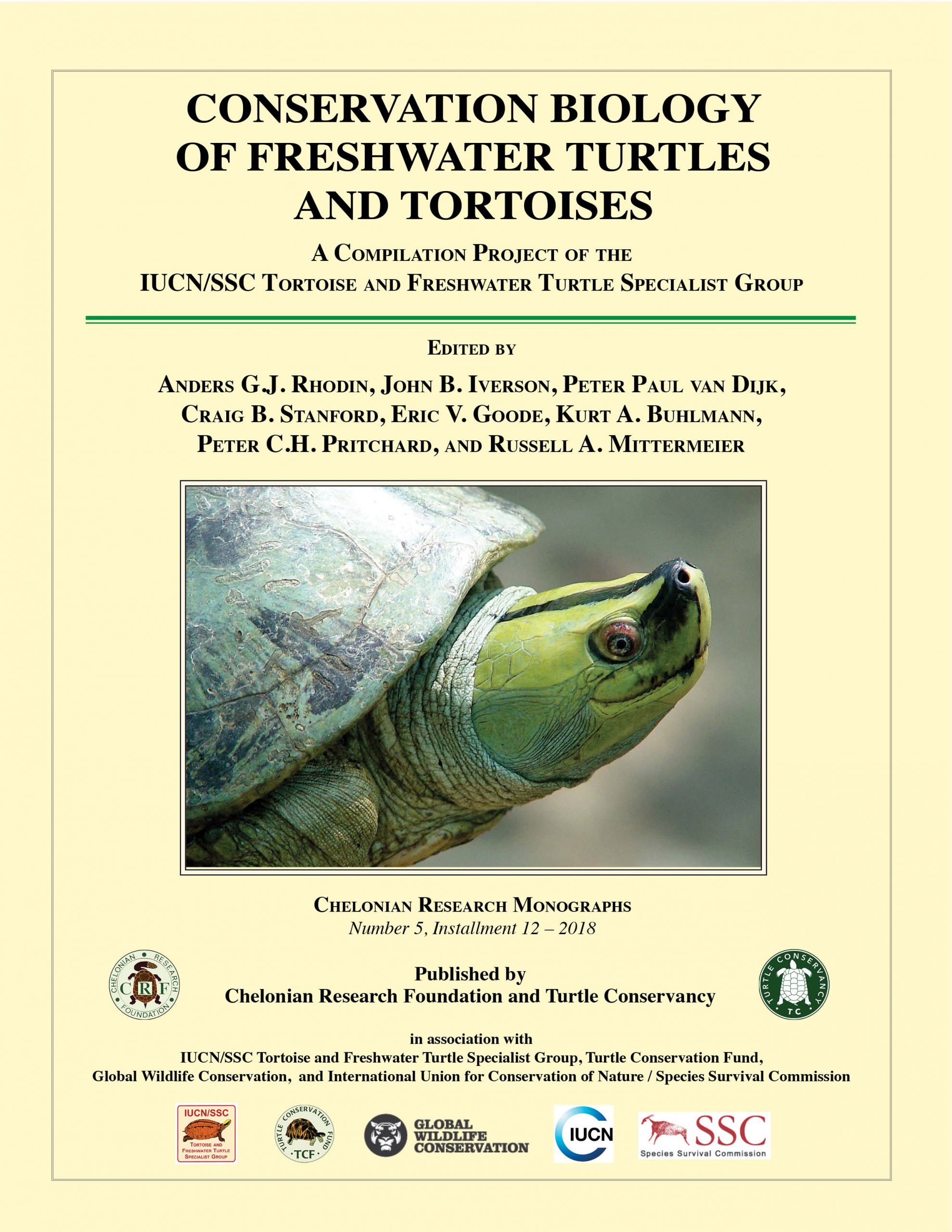
Cover Photo: Batagur trivittata, Burmese roofed turtle, male in breeding color at the Yadanabon Zoo, Mandalay, Myanmar, October 2005. Photo by Rick Hudson.
Contributing Authors 306
- Rafael Acuña-Castillo
- Rafael Acuña-Mesén
- Mohammad Firoz Ahmed
- Godfrey C. Akani
- Thomas S. Akre
- Erika A. Alacs
- Leandro Alcalde
- Matthew C. Allender
- Abdulaziz R. Alqahtani
- Ben Anders
- Ana Andreu
- Harald Artner
- Don T. Ashton
- Mehmet K. Atatür
- Mark Auliya
- Dinçer Ayaz
- Nicol Azcona-Orellana
- Patrick J. Baker
- Gabriel Barrios-Quiroz
- Dhruvajyoti Basu
- Mathias Behangana
- Andriws E. Bello-Suazo
- John Sebit Benansio
- Rafael Bernhard
- Neil P. Bernstein
- James F. Berry
- Kristin H. Berry
- Albert Bertolero
- S. Bhupathy
- Torsten Blanck
- Emmett L. Blankenship
- Brian C. Bock
- Roger Bour
- Jason R. Bourque
- Ortwin Bourquin
- Deborah S. Bower
- Richard C. Boycott
- Bruce J. Brecke
- Henrik Bringsøe
- Elizângela S. Brito
- Donald G. Broadley
- Rafe M. Brown
- William S. Brown
- Kurt A. Buhlmann
- Grégory Bulté
- Bernat Burriel-Carranza
- R. Bruce Bury
- Stephen D. Busack
- Salem M. Busais
- James R. Buskirk
- Brian P. Butterfield
- Taggert G. Butterfield
- Stephan Böhm
- Mario R. Cabrera
- John Cann
- John L. Carr
- Olga V. Castaño-Mora
- Adrián Cerdá-Ardura
- Eng Heng Chan
- Pelf Nyok Chen
- Tien-Hsi Chen
- Bruce Chessman
- Marc Cheylan
- Laurent Chirio
- James L. Christiansen
- Justin D. Congdon
- Ben Corey
- Fabio G. Cupul-Magaña
- Gladys Cárdenas-Arevalo
- Igor G. Danilov
- Indraneil Das
- M. Florencia David
- Jeffrey E. Dawson
- Juan M. Daza
- Marcelo S. de la Fuente
- Anslem de Silva
- V. Deepak
- Massimo Delfino
- Gift Simon Demaya
- Lamine Diagne
- Tomas Diagne
- Arvin C. Diesmos
- Mae Lowe L. Diesmos
- Shannon Diruzzo
- James L. Dobie
- C. Kenneth Dodd, Jr.
- J. Sean Doody
- Carmen Díaz-Paniagua
- Stefania D’Angelo
- Neil D’Cruze
- Carla Eisemberg
- Johannes Els
- David Emmett
- Kevin M. Enge
- Edem A. Eniang
- Joshua R. Ennen
- Daniel Escoriza
- Andrés Estrades
- Stephan Ettmar
- Michael A. Ewert
- Alejandro Fallabrino
- Shirley Famelli
- Renato G. Faria
- Phillipa Featherston
- Camila R. Ferrara
- Darren Fielder
- Nancy N. FitzSimmons
- Peter S. Floyd
- Damien A. Fordham
- Germán Forero-Medina
- Alastair Freeman
- Uwe Fritz
- Jinzhong Fu
- Natalia Gallego-García
- Carlos A. Galvis-Rizo
- Mario F. Garcés-Restrepo
- Georgios L. Georgalis
- Arthur Georges
- Justin Gerlach
- David J. Germano
- Hanyeh Ghaffari
- J. Whitfield Gibbons
- Alan Giraldo
- James C. Godwin
- Gracia Gonzalez-Porter
- J. Michael Goode
- Terry E. Graham
- Cris Hagen
- Adrian Hailey
- Andreas B. Hardian
- Timo Hartmann
- Veryl Hasan
- Jihène Ben Hassine
- Ronnie E. Hatcher
- Emmanuel M. Hema
- Douglas B. Hendrie
- Tom B. Herman
- Ha V. Hoang
- Kate M. Hodges
- Margaretha D. Hofmeyr
- Brian D. Horne
- Gabriel de F. Horta
- Jennifer G. Howeth
- Daniel F. Hughes
- Bonggi R. Ibarrondo
- Flora Ihlow
- Charles J. Innis
- John B. Iverson
- Dale R. Jackson
- Hossein Javanbakht
- Herdhanu Jayanto
- Gerald R. Johnston
- Robert L. Jones
- Hans-Volker Karl
- Rod Kennett
- A. Ross Kiester
- Flavius C. Killebrew
- Michael W. Klemens
- Win Ko Ko
- Cameron Kolthoff
- Yurii V. Kornilev
- Gerald Kuchling
- Jeffrey W. Lang
- Christopher J. Leary
- Peter V. Lindeman
- Barbara Livoreil
- Jeffrey E. Lovich
- Luca Luiselli
- Nadin E. López-González
- Marco A. López-Luna
- David W. Macdonald
- William E. Magnusson
- Patrick Kinyatta Malonza
- Thomas M. Mann
- Georgia Mantziou
- Pablo Marano
- Thiago S. Marques
- Federico Marrone
- Bradley T. Martin
- Fernando I. Martins
- Liudmila F. Mazanaeva
- William P. McCord
- Timothy E.M. McCormack
- C.J. McCoy
- Suzanne E. McGaugh
- Pearson McGovern
- Guido Fabián Medina-Rangel
- Elmar Meier
- Shai Meiri
- Walter E. Meshaka, Jr.
- Daniel O. Mesquita
- Peter A. Meylan
- Priscila S. Miorando
- Russell A. Mittermeier
- Don Moll
- Edward O. Moll
- Anirhuddha Mookerjee
- Geraldo J.B. Moura
- Eric C. Munscher
- Robert W. Murphy
- B.H.C.K. Murthy
- Reginald T. Mwaya
- Khin Myo Myo
- Sébastien Métrailler
- David H. Nelson
- Jacob Mueti Ngwava
- Jose Rafael Nolasco-Luna
- Cisca Nurfi’aini
- Fabrizio Oneto
- Hidetoshi Ota
- Dario Ottonello
- Charles W. Painter
- Michael J. Pappas
- James F. Parham
- Lorena Paszko
- Fabio Petrozzi
- Leland J.S. Pierce
- Kalyar Platt
- Steven G. Platt
- John R. Polisar
- Paulino Ponce-Campos
- Georgi Popgeorgiev
- Thiago C.G. Portelinha
- Peter Praschag
- Peter C.H. Pritchard
- Vivian P. Páez
- Irhamna P. Rahmawati
- Thomas R. Rainwater
- Madhuri Ramesh
- Rayavarapu J. Rao
- Benjamin M. Reed
- Luis E. Rentería-Moreno
- Adriana Restrepo
- Eduardo Reyes-Grajales
- Anders G.J. Rhodin
- Enrique Richard
- Lina Rifai
- John Roe
- Mark Rose
- Philip C. Rosen
- Nathan Rusli
- Walter Sachsse
- Daniel O. Santana
- Chuck Schaffer
- Rick Schaffer
- Sabine Schoppe
- Gabriel H. Segniagbeto
- Will Selman
- Saibal Sengupta
- H. Bradley Shaffer
- Uri Shanas
- Mohammed Shobrak
- Shailendra Singh
- Shashwat Sirsi
- Francisco Soberón-Mobarak
- Sitha Som
- Franco Leandro Souza
- Filippo Spadola
- Stephen Spawls
- Ricky-J. Spencer
- Craig B. Stanford
- Dirk J. Stevenson
- Marie E.B. Stone
- Paul A. Stone
- Richard P.J.H. Struijk
- James N. Stuart
- Jalma G. Sukmawati
- Thanda Swe
- Emerson Y. Sy
- Rocio Maria Sánchez
- Akio Takahashi
- Ertan Taskavak
- Kumthorn Thirakhupt
- Travis M. Thomas
- Scott Thomson
- Yaron Tikochinski
- Josephine V. Tirtayani
- Anton Tucker
- Elias Tzoras
- Oguz Türkozan
- Rafael M. Valadão
- Jorge H. Valdez-Villavicencio
- Melita Vamberger
- Peter Paul van Dijk
- Mario Vargas-Ramirez
- Karthikeyan Vasudevan
- Luciano M. Verdade
- Gustavo H.C. Vieira
- Sabine Vinke
- Thomas Vinke
- Richard C. Vogt
- Raju Vyas
- Andrew D. Walde
- Pratyaporn Wanchai
- Joseph P. Ward
- Robert G. Webb
- Michael Welsh
- Ronald E. Willemsen
- Lisabeth L. Willey
- Dawn S. Wilson
- Takashi Yabe
- Yuichirou Yasukawa
- André Yves
- Fengting Zhou
- Ting Zhou
- Marco Alberto Luca Zuffi
Project Photographers 336
- Collette Adams
- Leonardo Ramos Adriano
- Mohammad Firoz Ahmed
- Godfrey C. Akani
- Leandro Alcalde
- Patrick Alexander
- Abdulaziz R. Alqahtani
- Bhaba Amatya
- Ben Anders
- Carolina Sánchez Arias
- Don T. Ashton
- Mehmet K. Atatür
- Markus Auer
- Mark Auliya
- Tracy Baker
- Richard D. Bartlett
- Chittaranjan Baruah
- Jeff Beane
- Mathias Behangana
- Virginia C.D. Bernardes
- Rafael Bernhard
- Kristin H. Berry
- Albert Bertolero
- James B. Bettaso
- S. Bhupathy
- Torsten Blanck
- Michael S. Bogle
- Roger Bour
- Deborah S. Bower
- Richard C. Boycott
- Greg Brashear
- Bruce Brecke
- Raissa Bressan
- Henrik Bringsøe
- Elizângela S. Brito
- Rafe M. Brown
- William S. Brown
- Kurt A. Buhlmann
- Grégory Bulté
- Betty L. Burge
- R. Bruce Bury
- Stephen D. Busack
- James R. Buskirk
- Brian O. Butler
- Howard G. Byrne
- Alejandra Cadavid
- Matt Cage
- Young Cage
- John Cann
- John L. Carr
- Mandi Carr
- Viviana M. Cartagena
- Iriomote Wildlife Conservation Center
- Luis Ceriaco
- Eng Heng Chan
- Tien-Hsi Chen
- Laurent Chirio
- Blanca Azucena Chontal
- B.C. Choudhury
- Mary Clark
- Ana Colima
- Suzanne Collins
- Florida Fish and Wildlife Commission
- Desert Tortoise Preserve Committee
- Justin D. Congdon
- Turtle Conservancy
- Arturo Conteras-Arquieta
- Colin Croft
- Gladys Cárdenas-Arevalo
- Rio Dante
- Indraneil Das
- Shekar Dattatri
- Jeffrey E. Dawson
- Grupo Herpetológica de Antioquia
- Museo de Herpetología de la Universidad de Antioquia
- Anslem de Silva
- V. Deepak
- Pablo R. Delis
- Bernard Devaux
- Tomas Diagne
- James L. Dobie
- C. Kenneth Dodd, Jr.
- Jonathan Duran
- Carmen Díaz-Paniagua
- Stefania D’Angelo
- Neil D’Cruze
- Carla Eisemberg
- Johannes Els
- David Emmett
- Kevin M. Enge
- Joshua R. Ennen
- Daniel Escoriza
- Andrés Estrades
- Michael A. Ewert
- Alejandro Fallabrino
- Shirley Famelli
- Darren Fielder
- Paulo L. Filho
- Nancy N. FitzSimmons
- Karl Ford
- Damien A. Fordham
- Germán Forero-Medina
- Michael R.J. Forstner
- Alastair Freeman
- Joel Garcia
- Sourabh Gawan
- Peter Geissler
- Arthur Georges
- Justin Gerlach
- David J. Germano
- Hanyeh Ghaffari
- Tom Gill
- Alan Giraldo
- San Diego Zoo Global
- James C. Godwin
- Egbert Golz
- Gracia Gonzalez-Porter
- Terry E. Graham
- Sally Grundy
- Ferry Grünewald
- Wulf Haacke
- Cris Hagen
- Adrian Hailey
- William M. Hammond
- Andreas B. Hardian
- James H. Harding
- Jiri Haureljuk
- George Heinrich
- Dean A. Hendrickson
- Mario Herz
- Terry Hibbitts
- Pierson Hill
- Lina Hinestroza
- Kate M. Hodges
- Margaretha D. Hofmeyr
- Dan C. Holland
- Brian D. Horne
- Gabriel de F. Horta
- Janet Hostetter
- Jennifer G. Howeth
- Rick Hudson
- Daniel F. Hughes
- Flora Ihlow
- Steve Ishii
- WWF Italia
- John B. Iverson
- Dale R. Jackson
- Hossein Javanbakht
- S. Jayakumar
- Karen A. Jensen
- Jason M. Jones
- Michael T. Jones
- Robert L. Jones
- Tyler Jones
- Nobuhiro Kawazoe
- C.K. Kelly
- Anser Khan
- Heng Kimchhay
- John Kleopfer
- Win Ko Ko
- Lukáš Kratochvíl
- Gerald Kuchling
- Gunther Köhler
- Brian Lang
- Sally Lanigan
- Michael Lau
- Thomas Leuteritz
- Peter V. Lindeman
- Scott Loarie
- Victor Loehr
- Paula C. Lopes
- Bill Love
- Jeffrey E. Lovich
- Nguyen Thanh Luan
- Gary Luciano
- Luca Luiselli
- Nora López-León
- William E. Magnusson
- Thomas M. Mann
- Georgia Mantziou
- Maurizio Marchese
- Thiago S. Marques
- Federico Marrone
- Ramon Mascort
- Joaquim Soler Massana
- Mark Massar
- Brooke N. Massengill
- Jeremy K. Massengill
- Carl D. May
- Liudmila F. Mazanaeva
- William P. McCord
- Timothy McCormack
- Suzanne E. McGaugh
- Pearson McGovern
- Ann McLuckie
- Konrad Mebert
- Pratheep Meewattana
- Fernanda Melo
- Khaled Merabet
- Peter A. Meylan
- Marsha Miller
- Russell A. Mittermeier
- Asghar Mobaraki
- Don Moll
- Edward O. Moll
- Robert H. Mount
- Reginald T. Mwaya
- Melvin Mérida
- Sébastien Métrailler
- Rahul Naik
- Greg Norsworthy
- Andy Noss
- Cisca Nurfi’aini
- Andreas Nöllert
- Jennifer Wallin Oliver
- Annette Olsson
- Dario Ottonello
- Mathieu Ouellette
- Charles W. Painter
- James F. Parham
- Fred Parker
- Lorena Paszko
- John Pemberton
- Jarmo Perälä
- Petr Petras
- Fabio Petrozzi
- Hans-Dieter Philippen
- Kalyar Platt
- Håkan Pohlstrand
- James Poindexter
- Paulino Ponce-Campos
- Georgi Popgeorgiev
- Frank Portillo
- Peter Praschag
- Mojave Natural Preserve
- Peter C.H. Pritchard
- Jayaditya Purkayastha
- Vivian P. Páez
- Evan S.H. Quah
- Truong Nguyen Quang
- Rayavarapu J. Rao
- S.M.A. Rashid
- Freya Reder
- Michael Redmer
- Renae Reed
- Paul Reef
- André de Paula Reis
- Eduardo Reyes-Grajales
- Anders G.J. Rhodin
- Enrique Richard
- Casey Richart
- Lina Rifai
- Maurice Rodrigues
- John Roe
- Cameron Rognan
- José Vicente Rueda-Almonacid
- Oliver Römpp
- Fatehi Al Saaw
- Walter Sachsse
- Barbod Safaei-Mahroo
- Suzy Sanoja-Sarabia
- Daniel O. Santana
- Patty Scanlan
- Rita Scardino
- Chuck Schaffer
- Rick Schaffer
- Fabian Schmidt
- Christoph Schneider
- Willi Schneider
- Sabine Schoppe
- Jake Scott
- Gabriel Hoinsoudé Segniagbeto
- Will Selman
- Uri Shanas
- Liron Shapira
- Chris Shepherd
- Haitao Shi
- Rowan Simon
- Shailendra Singh
- Shashwat Sirsi
- Alex Slavenko
- Sitha Som
- Franco L. Souza
- Stephen Spawls
- Nathanael Stanek
- Craig B. Stanford
- Brian D. Stanila
- Brett Stearns
- Dirk J. Stevenson
- Bev Steveson
- Kevin Stohlgren
- Marie E.B. Stone
- Paul A. Stone
- Richard P.J.H. Struijk
- James N. Stuart
- U.S. Geological Survey
- Emerson Y. Sy
- Steffen Szymanski
- Ertan Taskavak
- Travis M. Thomas
- Jack Thompson
- Robert C. Thomson
- Stanley E. Trauth
- Claire Treilibs
- Apostolis Trichas
- Ashutosh Tripathi
- Anton Tucker
- Michael Tuma
- Elias Tzoras
- Oğuz Türkozan
- Rafael M. Valadão
- Jorge H. Valdez-Villavicencio
- Melita Vamberger
- Thomas R. Van Devender
- Peter Paul van Dijk
- Nguyen Van Sang
- Jhonattan Vanegas
- Karthik Vasudevan
- Jay Villemarette
- Thomas and Sabine Vinke
- John Visser
- Evangelos Vlachos
- Richard C. Vogt
- Raju Vyas
- Andrew D. Walde
- Pratyaporn Wanchai
- Joseph P. Ward
- Peter Wellings
- Ronald E. Willemsen
- Lisabeth L. Willey
- Dawn S. Wilson
- Yuichirou Yasukawa
- Ting Zhou
- Gembira Loka Zoo
- George R. Zug
- Jan Červenka